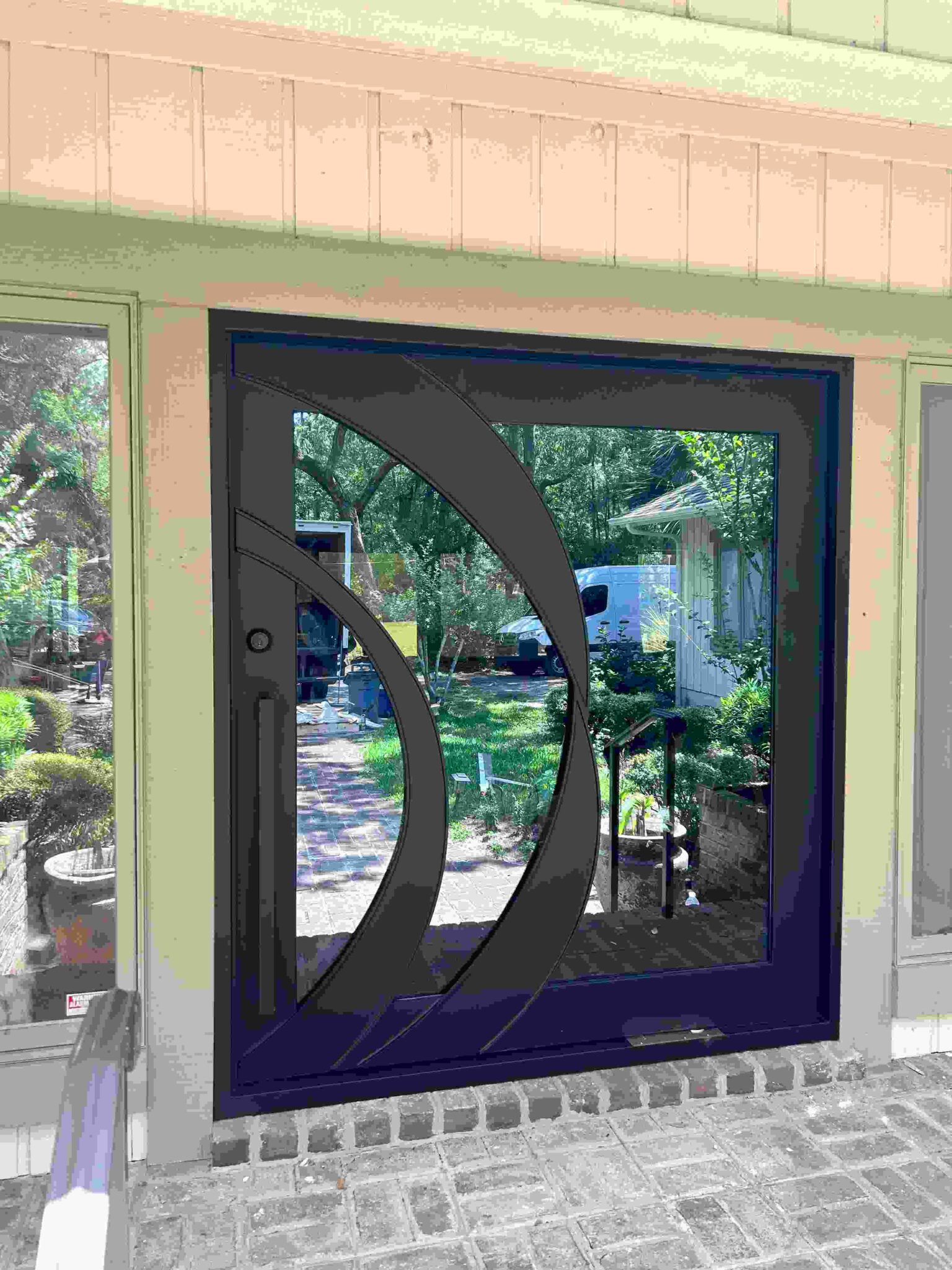
Pivot doors have captured the imagination of Charleston homeowners seeking dramatic architectural statements. These distinctive entries operate differently from traditional hinged doors, creating visual impact impossible to achieve with conventional configurations.
But what exactly is a pivot door? How does it work? And is it the right choice for your Charleston home? At Forever Iron Doors Carolina, we fabricate and install custom pivot doors in iron throughout the Charleston area. Let’s explore everything you need to know.
What Is a Pivot Door?
A pivot door is an entry door that rotates on a vertical axis through pivot hinges positioned at the top and bottom of the door, rather than hinges mounted along the side edge. This fundamental difference in operation creates distinctive aesthetics and enables capabilities impossible with traditional hinged doors.
According to Clark Hall Doors, pivot doors feature “hidden hardware and hinges that make a tidy appearance and offer security.” The sleek design with seamless entry makes them a perfect match for clean lines of modern designs.
Historical Context
Pivot doors aren’t a modern invention. According to Brennan Enterprises, “these doors operated on pivots that allowed the door to swing open” in ancient structures. Prior to pivot doors, structures likely used slabs of stone to block passageways. Modern engineering has refined this ancient concept for contemporary applications.
How Pivot Doors Work
The Pivot Mechanism
Unlike hinged doors where weight transfers through side-mounted hinges to the door frame, pivot doors transfer weight directly to the floor through a bottom pivot and are stabilized by a top pivot.
According to AproDoor, “thanks to the pivot hardware, these doors can support extra-wide or heavy panels that would be too much for standard hinges.” This floor-based weight distribution is the key engineering advantage.
Pivot Placement Options
Pivot points can be positioned in several locations. Center pivot places the rotation point at the door’s center, creating equal swing on both sides. Offset pivot positions the pivot point off-center (typically 1/3 from one edge), creating unequal swing patterns. Most residential applications use offset pivots, allowing most of the door to swing in one direction while a smaller portion swings opposite.
Opening Operation
When you push or pull a pivot door, it rotates around its vertical axis. The door’s weight, balanced on the floor pivot, requires minimal effort to move despite potentially massive size and weight. Quality pivot systems include hydraulic closers for controlled, smooth operation.
Pivot Door Designs for Charleston Homes
Contemporary and Modern
Charleston’s newer luxury developments showcase pivot doors’ modern potential. Contemporary designs feature floor-to-ceiling heights (often 10-12 feet), minimal frame profiles, expansive glass panels, clean geometric shapes, and matte black or bronze finishes.
Daniel Island and Mount Pleasant’s contemporary homes frequently feature pivot entries creating immediate architectural impact. The scale possible with pivot doors (impossible with hinged alternatives) defines these dramatic entrances.
Transitional Styles
Transitional pivot doors bridge contemporary engineering with traditional aesthetics. These designs incorporate iron frames with subtle detailing, divided light patterns, warm metal finishes, and proportions respecting Charleston’s architectural heritage.
Iron Pivot Doors
Custom iron pivot doors from Forever Iron Doors Carolina combine pivot engineering with iron’s strength and design flexibility. Iron allows large-format doors with intricate detailing, custom glass configurations, virtually unlimited finish options, and security features integrated into dramatic designs.
Advantages of Pivot Doors
Support for Larger, Heavier Doors
This represents pivot doors’ primary functional advantage. According to Clark Hall Doors, pivot doors “are often more durable, since there are not as many pieces that can become damaged or worn with age.”
Traditional hinged doors become problematic above certain sizes because hinges transfer weight to door frames, which can weaken over time. Pivot doors transfer weight to the floor, enabling doors 8-12 feet tall and 4-5 feet wide that would overwhelm conventional hinge systems.
Stunning Visual Impact
According to Urban Front, “the main benefit of a pivot door is undoubtedly that it looks stunning (and expensive!).” The absence of visible side hinges creates exceptionally clean lines that photograph beautifully and impress visitors.
Smooth Operation
Despite their size, well-engineered pivot doors operate effortlessly. The balanced weight distribution means even heavy iron and glass doors swing open with minimal force. Hydraulic closers ensure controlled, elegant movement.
Architectural Flexibility
Pivot doors accommodate unconventional designs including asymmetric panels, unusual shapes, integrated sidelights, and creative glass configurations that hinged doors cannot support.
Durability
According to Clark Hall Doors, pivot doors “offer a more sleek, unique look, and they are often more durable.” With fewer moving parts and no side hinges to sag or fail, quality pivot doors maintain smooth operation for decades.
Disadvantages of Pivot Doors
Weather Sealing Challenges
This represents pivot doors’ most significant limitation. According to DigsDigs, pivot doors “cannot be sealed fully like traditional doors, they are difficult to weatherstrip.”
The pivot mechanism creates small gaps at corners that standard weatherstripping cannot fully address. For Charleston’s occasional driving rain and humidity, this limitation requires consideration.
Space Requirements
According to Panda Windows, “while they save space in terms of clearance, the pivot mechanism requires a wider doorway than standard hinged doors.”
Because pivot doors swing partially in both directions from the pivot point, they require clearance on both sides of the opening. This can prove problematic for tight Charleston entryways or compact foyers.
Higher Costs
Pivot doors cost more than comparable hinged alternatives. According to Clark Hall Doors, “pivot doors are generally more expensive” due to “specialized systems, structural requirements, and custom materials.”
Expect pivot door installations to cost $500-$2,000+ more than comparable hinged doors, not including the door itself.
Complex Installation
According to Clark Hall Doors, “pivot door installation is more complex” and requires “professional installation.” Installation typically requires “additional work to increase doorway size” and floor preparation for proper mounting.
Potential Safety Concerns
According to discussions on Houzz, “these doors have the potential to be a safety concern for the very young and the very old especially if there is no hold open or closer involved.” The dual-direction swing can catch people unaware.
Pivot Doors and Charleston’s Climate
Charleston’s coastal environment creates specific considerations for pivot door selection.
Weather Exposure
For primary exterior entries directly exposed to weather, pivot doors’ sealing limitations require honest evaluation. Protected entries (deeply recessed under porches or porticos) minimize exposure concerns. Direct weather exposure may favor hinged alternatives.
Hurricane Considerations
Pivot doors can be engineered for impact resistance, but the sealing challenges become more pronounced during severe weather. Charleston homeowners in flood-prone or wind-exposed areas should discuss hurricane performance with installers.
When Pivot Doors Work Well
Pivot doors excel in Charleston applications including protected front entries with porch coverage, interior applications (wine cellars, office entries, room dividers), contemporary homes prioritizing design impact, and secondary entries facing less severe weather exposure.
Making Your Decision
Choose Pivot Doors When:
- You’re designing a contemporary Charleston home where modern aesthetics are priorities
- Your entry is protected from direct weather exposure
- You want to create a grand, dramatic entrance
- You’re willing to invest in premium quality and professional installation
- Your budget accommodates higher costs for exceptional impact
Choose Hinged Doors When:
- Your home is in Charleston’s historic district requiring traditional aesthetics
- Your entry faces direct weather exposure without protection
- Space constraints limit clearance on both sides of the opening
- Budget optimization is a primary concern
- You’re matching existing architectural elements
The Forever Iron Doors Carolina Approach
At Forever Iron Doors Carolina, we fabricate exceptional custom iron doors in both pivot and hinged configurations. Our experience throughout Charleston helps homeowners evaluate which configuration best suits their specific situation.
We provide honest guidance considering your home’s architecture, site conditions, weather exposure, and aesthetic goals. Whether you select pivot or hinged configuration, we fabricate doors to your exact specifications with the quality Charleston’s finest homes deserve.
Our certified installers understand pivot door requirements including floor preparation, proper alignment, closer adjustment, and finishing details that ensure long-term performance.
Transform Your Charleston Entry
Pivot doors offer dramatic architectural impact impossible to achieve with conventional configurations. For the right application, they create unforgettable first impressions that define your home’s character.
Understanding how pivot doors work, their advantages and limitations, and their suitability for Charleston’s climate helps you make informed decisions about whether this distinctive door style suits your needs.
Ready to explore pivot door options for your Charleston home? Contact Forever Iron Doors Carolina today for a free consultation. We’ll evaluate your specific situation and help you determine whether a pivot door or traditional hinged configuration best serves your vision.